Complete documentation chains
Sampled packages with all links and evidence defined in the audit protocol / total packages sampled × 100.
The sample should include shifts and exceptions; a completed field without evidence does not meet the criterion.

Explore Tervali topics
No topics found. Try “processes”, “Caremap” or “training”.
Sterile processing and process safety
How to structure traceability in the sterile processing department (SPD), link sets and cycles to distribution, handle exceptions, and measure records, with RDC 15 and the regulatory review verified.

Traceability in the SPD requires being able to recover the link between the item, its processing, its release, and its destination. An identifier only becomes useful when it is tied to verifiable events and allows the path to be investigated in both directions, including returns and holds.
When there is a question about a given processing run, management needs to find out which sets went through it, where they went, and which records supported their release. When those answers depend on memory or searches through unlinked documents, the problem goes beyond not having software. What is missing is a chain of evidence that survives shift changes and exceptions.
This article focuses on the operational organization of the sterile processing department (SPD), known in Brazil as the Central de Material e Esterilização (CME). The proposed registry, metrics, and pilot are management analyses to be validated with the technical lead and the departments involved. No times, temperatures, pressures, concentrations, or other sterilization parameters are provided, nor instructions for selecting or changing cycles.
In the official text consulted on October 26, 2026, articles 25 and 26 of RDC 15/2012, the Anvisa regulation on processing of health products, establish lot-level documentation for Class II SPDs and contract reprocessing companies and allow either a manual or an automated system. Retention follows specific legislation or, in its absence, a minimum of five years. The service's classification should take article 3 into account. [1]
Anvisa approved proposals for public consultation in September 2026. The Brasil Participativo portal lists CPs 1.420 to 1.423, related to health services, reprocessing companies, quality assurance, and device classification. [2][3] These are proposals, not automatically effective replacements. In the sources consulted, no final act replacing RDC 15 was identified. Before revising institutional procedures, check how these processes evolve and the applicable health regulatory guidance.
As an operational design, distinguish the individual instrument, the set composition, and the package prepared for a given processing run. The name minor surgery tray can identify a type of set, but it does not distinguish two trays in use at the same time or their compositions at different moments. The registry must make it possible to answer which set that was and which components were associated with that preparation.
Start with the level of detail needed to answer the service's questions. Individual identification may be appropriate for certain instruments; in other cases, traceability starts with sets and packages. Do not promise to locate a specific piece if the system only records the set. Also preserve the history of replacements: updating the current record must not rewrite the composition of a past processing run.
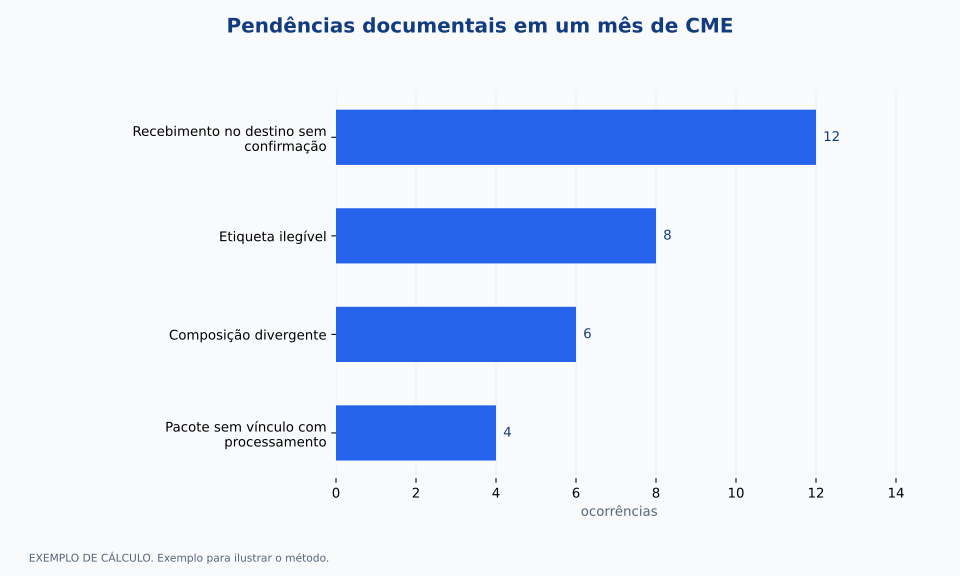
Thirty issues, each classified by one primary cause. Absolute count of documentation issues; does not measure contamination, sterility, or clinical incidence.
| Category | issues |
|---|---|
| Receipt at destination not confirmed | 12 |
| Illegible label | 8 |
| Mismatched composition | 6 |
| Package not linked to processing | 4 |
Process map for discussing responsibilities and handoff points with your teams. Adapt it to your institution’s context.
Intake links origin, set, and discrepancies.
The performing team documents steps according to applicable technical procedures.
Preparation preserves composition, package identity, and required identification.
The team links packages to the run and the corresponding evidence.
The responsible professional documents the decision and pending items according to applicable criteria.
Sterile storage records release; destination confirms receipt.
The receiving unit records the applicable event and keeps a searchable link.
SPD and quality retrieve the path in both directions and address gaps.
For each step, consider an identified input, a verifiable output, and a person or role responsible for the record. The WHO and PAHO manual treats reprocessing as work that depends on coordinated infrastructure and procedures, providing a technical reference that complements Brazilian legislation. [4] The map below summarizes transfers of responsibility and does not function as a processing protocol.
At intake, link the origin to the set received and record discrepancies. At preparation, associate the verified composition with the package. During processing, preserve the link between packages and the recorded run. At distribution, keep the confirmed destination. A shift change should transfer pending documentation items with a defined owner, so the next team does not have to reconstruct decisions from loose sheets of paper.
The proposed registry needs to separate completion of a step, available result, and release decision. A completed cycle record does not by itself show that all relevant checks were evaluated. It is up to the responsible professionals to apply the current technical and institutional criteria. The system should make pending items visible and record who decided, when, and based on which evidence, without replacing that assessment.
The label is also part of the chain: articles 83 to 85 of RDC 15 cover identification, legibility, and label information, including product, lot, relevant dates, method, and person responsible for preparation. [1] As a system proposal, maintain a searchable identifier that connects the package to internal evidence. Test scanning and lookup under real transport and delivery conditions, without changing technical packaging requirements.
Distinguish release from sterile storage, receipt by the unit, opening or use, and return unused. Delivery to the operating room does not prove use in a procedure. To link the package to its use, the responsible team needs to record that event in the appropriate clinical workflow. This integration is an operational design proposal; its scope must be agreed upon and cannot be assumed from a scan at dispatch.
If there is a link to the health record, use institutional identifiers and access consistent with job responsibilities. Management dashboards can show status and pending items without exposing patient identification. When a package is returned, record its origin and reason before the routing defined by the responsible person. Avoid simply returning it to available inventory because the physical count reappeared: its history and condition need to be evaluated.
An illegible label, a duplicate identifier, a mismatched composition, or a missing documentation link should open a visible pending item. Define who assesses the case and what evidence allows it to be closed. A free-text field that accepts any justification can make administrative closure easy while leaving the root cause in place. On the other hand, a hold with no owner can turn the system into a queue that no one can clear.
In the proposed design, each correction keeps the previous value, new value, reason, author, and time. The goal is to allow later review. During downtime, use forms with controlled identification and defined reconciliation, preserving both the time of the event and the time of later entry. This makes it possible to distinguish data entry delays from a real lack of information, without pretending that the system was available when the event occurred.
The chart contains an example of 30 documentation issues in one month: 12 with no confirmation of receipt at the destination, 8 with an illegible label, 6 with a mismatched composition, and 4 with no link between the package and the processing run. Each issue has one primary category.
In this example, the largest category would point to an investigation of the handoff between dispatch and receipt, not an automatic conclusion about processing quality. It would be necessary to observe the work and check for possible records in another system. The total number of documentation failures is also not an infection rate or a direct measure of sterility. Use the example to practice questions and criteria, without treating it as a performance benchmark.
Completeness should evaluate a predefined chain, with origin, identifiers, evidence, decision, and destination. Counting completed fields is not enough. Take a sample and try to reconstruct the path without relying on anyone's memory. Record the time and the gaps. In another test, start from a package and find the associated records; then start from a processing run and locate the corresponding destinations.
Also track documentation rework and returns, always with stable denominators and criteria. A better rate may result from improperly excluding exceptions or from an easier sample. That is why checks should be spread across shifts and include different types of sets. The metrics proposed below evaluate information management; improvement in them does not by itself demonstrate clinical safety or full regulatory compliance.
Choose one family of sets and follow a complete path, with participation from the SPD and the receiving unit. Observe intake, preparation, records, distribution, and return. Include an unreadable label, an incomplete set, and system downtime in controlled exercises. Use fictional data in the exercises and keep a clear separation between training and real operational records.
If there is a contract reprocessing company, test whether the identifiers and documents received make it possible to reconstruct the path between organizations. Availability of an external portal does not guarantee future access to the history. Agree on export, correction responsibilities, and record retrieval. Expand the scope only after proving lookups in both directions and handling of pending items, with technical validation. Software can support this chain, but it does not by itself provide physical capacity, staff, or professional judgment.
Check off the items already in place. Use the rest as a working agenda.
Sampled packages with all links and evidence defined in the audit protocol / total packages sampled × 100.
The sample should include shifts and exceptions; a completed field without evidence does not meet the criterion.
Median minutes between the lookup request and retrieval of the required links in documented exercises.
Report the number of exercises and incomplete searches; use comparable tasks.
Deliveries whose local confirmation deadline passed with no destination record / total deliveries with an expired deadline in the period × 100.
A proposed logistics control with no universal deadline; do not confuse lack of confirmation with proven loss.
Processing runs with at least one later documentation correction / total processing runs in the period × 100.
Classify the reason and preserve versions; a drop may reflect fewer errors being identified.
Article 26 allows either a manual or an automated system. [1] The choice must demonstrate record retrieval and consistency, and work under the service's real conditions.
No. It is an identification tool. Technical assessment depends on the process and the relevant evidence. The code must allow the history to be looked up, without being treated as a self-sufficient certificate.
Primary sources used to produce this content. Implementation recommendations should be adapted and validated by each institution.
Scope, lot documentation, information system, record retention, and package identification, articles 3, 25, 26, and 83 to 85. Sterilization parameters are not reproduced.
Decision on public consultation proposals for medical device processing; shows that a review is underway, not that a replacement regulation is in force.
Official list of proposals on health services, reprocessing companies, quality assurance, and device classification. Final deadlines were not reproduced because the listing consulted contains a year inconsistency.
Complementary reference on coordinating infrastructure and procedures in reprocessing; does not replace Brazilian legislation or validate local operating parameters.
Educational content on management and technology. It does not replace professional judgment, current regulations or clinical protocols.
KEEP EXPLORING